Tag: self-help
I’ve Sold Over 10,000 Copies of My Books. Here’s the Good, the Bad and the Ugly.
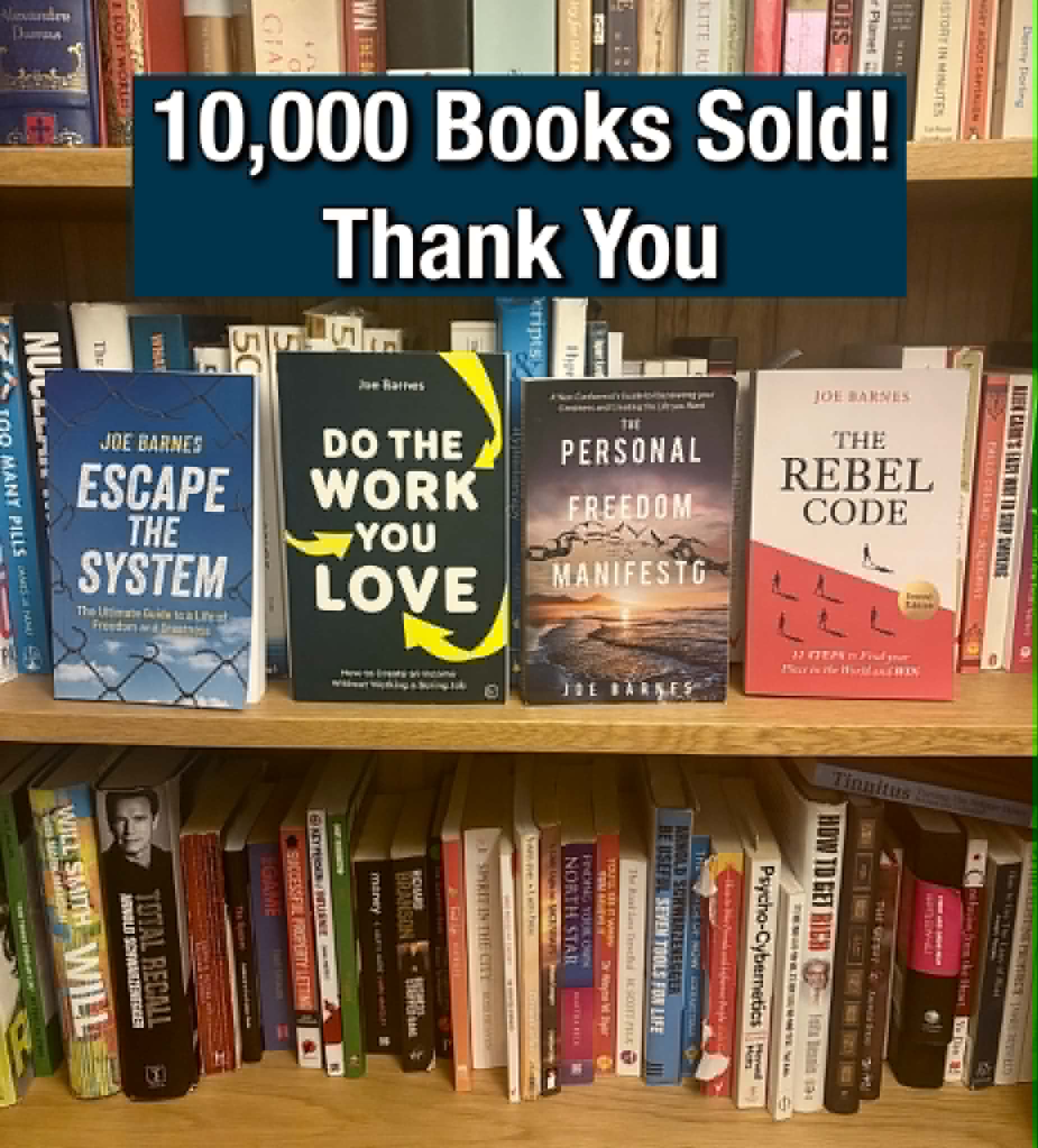
I’ve now sold 10,000 copies of my books.
Are you impressed by that number?
Don’t misunderstand this question, I’m not fishing for compliments. I’m genuinely so caught up in my work, and the titanic struggle it’s been to get to this number, that I don’t really have any perspective.
On the one hand, it seems like an impressive number. Furthermore, I just asked Gemini what it thought of my sales and this is what it said, “Take a moment to celebrate. You have beaten the statistical odds of the publishing industry by a landslide.”
It then went on to tell me that roughly 96% of all books published sell fewer than 1000 copies in their entire lifetime.
Here’s the breakdown of my sales.
Escape The System (2012) 5500 sales
Do The Work You Love (2020) 1000 sales
The Personal Freedom Manifesto (2021) 1500 sales
The Rebel Code (2023) 2000 sales
So, every single book I’ve written is in the top 4% for copies sold. Furthermore, with one book at over 5000 sales, I’m in the top 10% to 13% of all published writers, including those with major publishers.
So, why don’t I feel like more of a success?
The Details
Don’t get me wrong, I’m hugely appreciative of my 10,000 sales. Achieving this milestone ranks amongst the greatest successes of my life. Furthermore, I feel like something has shifted.
I have a new level of confidence and belief. I feel established.
And yet . . . when you factor in the length of time it’s taken me to reach this milestone, it no longer seems so impressive (at least not to me).
It’s taken me 14 brutal years to make this breakthrough. That’s less than 1000 copies sold per year.
Not so impressive now, right?
Of course, this isn’t 14 years of me working full-time as a writer.
Instead, I’ve averaged around 800 hours per year for this time period. That’s about 18 hours a week (for the rest of the time, I’ve worked as a tennis coach and hypnotherapist).
Not all of these 18 hours have been effective.
It frustrates me to say that about half of them have been wasted trying to build an audience on social media, making unimpactful Tube videos, featuring on podcasts that didn’t drive any sales and writing book proposals for publishing companies that never got back to me (ironically, the one book deal I got, I didn’t write a proposal).
So, there’s been a lot of wasted effort and difficulty in building momentum but, still, 14 years is a long period of time. I feel like I should have done more.
A lot more . . .
The Long Term Goal
The next thing I’m going to say might surprise you.
What do you think my writing goal is?
Considering I’ve been writing for 14 years and “only” got to 10,000 sales, you may think I want to reach 100,000 or that I might have my sights set on making £1000 a month to supplement my regular income.
These are good goals for any author to have. However, they aren’t mine.
I want to sell 1 million copies of my books.
It doesn’t matter how many books I have to write to do this, I want to cross the 1 million sales mark (and this excludes audiobook sales and KU pages read – which I haven’t included in my 10,000 sales total).
So, bearing that in mind, how far have I come on my journey?
1% of the way.
Or, to put it differently, I still need to sell 990,000 copies of my books.
Perhaps now you understand why reaching 10,000 sales has been bittersweet for me.
But let’s not dwell on the negatives.
There have been some truly amazing moments on this journey.
Why I Write
For me, the best thing about being a writer is the response I get from readers. Whether that’s in the form of a review on Amazon or Goodreads or an email in my inbox, nothing beats hearing from someone who’s been impacted by my books.
To say it makes my day is an understatement. It energises me. More than that, though, it makes me feel like I’m living my life’s purpose.
You see, I break the cardinal rule for writing self-help books. I DON’T write for market.
This approach is contrary to what every so-called expert in book marketing preaches. Their message is universally similar – solve a problem people are struggling with, find a term that gets searched frequently on Google or Amazon, or locate a niche that’s hot at the moment, and write a book for this audience.
On the surface, this makes sense. It’s smart to make sure there’s an audience for something you’re creating. However, the problem I’ve encountered is that I have zero inspiration to write about habits, introverts, leadership or stoicism (for me, this is the cinematic equivalent of endless sequels and franchise reboots – there’s no originality).
I want to go deeper. I want to get to the core of what’s holding people back from changing their lives – the system we live in and how that crushes our outlook and self-belief.
That’s why I get so pumped when a reader is impacted by my books.
I feel like I’ve made a connection. I feel like I’ve been heard and, more importantly, they’ve been heard.
There are few things in life as great as that.
How Much Have I Been Paid As A Writer?
But what about the money, I hear you say?
To be honest with you, it’s inconsequential at this level. Any money I make goes straight back into Amazon ads, the operating costs of building and running a website, occasional promotions and paying for book covers.
If you really want to know, I estimate that I’ve made about £15,000 from my 10,000 book sales. It might be a little more than this as I try to make £2 per copy sold. However, I’ve now run so many promotions where I sell my books for $0.99 that it’s bringing the average down.
Of course, writing books opens up more financial opportunities than just selling books. Off the back of my books, I’ve picked up other writing jobs and made some money from coaching. However, this sum isn’t enough to replace my regular income and I don’t think it ever will until I start selling tens of thousands of copies per year.
Is that possible?
Call me delusional but I believe it is.
I’ve always believed it is. That’s what started this dream of becoming a bestselling self-help author.
When I was 22, I had a vision of myself speaking on a stage and inspiring people with my words.
I then remembered the life changing impact that some very powerful books have had on me (The Power Of Your Subconscious Mind, As A Man Thinketh, The Celestine Prophecy), and thought, “If I can do for someone else, what these books have done for me, that would be truly incredible.”
That vision was so real to me it felt like destiny.
So, despite all the difficulty I had in writing my first book (I rewrote it four times), my total lack of marketing knowledge, my aversion for technology while operating a business that’s 90% online and week after week of checking books sales and seeing a measly 1 or 2 on the Amazon dashboard, my belief hasn’t wavered and my dream has kept me going.
Of course, my successes have also kept me going. Throughout my writing career, I’ve had just about enough success to justify the continuation of my journey while never quite achieving the breakthrough I’ve desired.
It’s a frustrating paradox. However, I’m still here and my sights are now set on the next milestone – 100,000 sales.
The Secret To Selling More Books
But what if I had my time again?
What would I do differently if I could rewind the clock to 2012 when I released my first book?
The answer is simple: WRITE MORE BOOKS.
I have an author friend called Thibaut Meurisse. We both started out at around the same time. While I’ve just crossed the 10,000 sales barrier, he’s well passed the 1,000,000 sales mark.
His secret?
As far as I can tell, and he’s alluded to this in interviews as well, his prolific output is the reason for his success.
He releases between 4 and 5 books a year and has a catalogue of close to 30 books.
Yes, some of his title choices are excellent as well – Master Your Emotions, Dopamine Detox – but with every book he releases, he gives himself a greater chance for some of them to become perennial sellers.
Now, unless I quit my other jobs (and even then I doubt it would be possible), I’m not capable of writing and releasing 4 to 5 books a year. However, I can do one a year, every year.
This is my new focus.
My next title, scheduled to be released in December of this year, is “Self-Improvement is M*sturbation.” This book is based on 5 key philosophical tenets from the film Fight Club, that once applied to your life, will transform you in ways you wouldn’t have imagined possible. (If you’re interested in learning more about this book, and want a discount on it when launched, subscribe to my newsletter below).
After that, I’ve got plans for a new book release in 2027, a course in 2028, and another book in 2029. Let’s see how it goes.
Thank You
Not 1 of my 10,000 sales would be possible without you. So, I just want to say a massive thank you for buying my book, leaving a review, recommending it to others and believing in my work. It means the world to me and I’m eternally grateful.
GET YOUR FREE COURSE
If you want to discover a passion you can make a living from and overcome the fears that are holding you back, check out my free course 30 Days to Escape The System. Click here to get the course right now! (You’ll find the tips on developing belief and self-confidence fascinating!)
How Michael Jackson Used “The 48 Laws Of Power” To Conquer The World

First things first, let’s address the elephant in the room.
Michael Jackson may not have read “The 48 Laws Of Power.” The time line is a little off.
Robert Greene’s classic was published in 1998. By this time, Michael Jackson had already hit his peak and was on the downslide (although still astronomically famous and influential). Did he ever read the book?
I don’t know. There is evidence he was interested in self-help, psychology and spiritual books (he even thanks Deepak Chopra on the Dangerous album sleeve and writes about the power of the subconscious mind in his autobiography, Moonwalk). However, he was never pictured with, or mentions, “The 48 Laws Of Power.”
What is uncanny, though, is that before he hit his peak and throughout his career, he used some of the EXACT strategies Robert Greene would write about in his classic book.
So, while I don’t believe Michael Jackson read “The 48 Laws Of Power,” his rise to world domination validates much of Greene’s writing.
In this article, I’m going to look at exactly which of the 48 laws MJ mastered and break them down so that you can use them in your own quest for success and domination.
Law 6: Court Attention At All Costs
Greene writes,
Never let yourself get lost in the crowd, then, or buried in oblivion. Stand out. Be conspicuous, at all cost. Make yourself a magnet of attention by appearing larger, more colorful, more mysterious than the bland and timid masses.
The black fedora. The single white glove. The black loafers with white socks so you couldn’t keep your eyes off his feet.
Michael Jackson knew exactly how to court attention. Even his singing was littered with unique vocal ticks (a hee hee or a shamone) which made him stand out.
Michael Jackson made himself instantly recognisable and it wasn’t an accident. Back in 1979, when touring with his brothers, he wrote the following note to himself on a tour bus,
MJ will be my new name. No more Michael Jackson. I want a whole new character, a whole new look. I should be a totally different person.
What’s unique about you? How can you accentuate this?
Creating a cringey gimmick will probably repel an audience and do the reverse of what you desire. However, if you can take who you already are and, with your clothing, a catchphrase or your mannerisms, turn up the dial on this personality, you might find something that’ll make you memorable.
Law 7: Get Others To Do The Work For You, But Always Take The Credit
Prince and Michael Jackson were rivals in the 1980s. Although Michael was more popular, some people would say that Prince, with his musical pedigree (he could play almost every instrument) was the greater artist.
Was this true?
From a purely musical point of view, perhaps. However, I think all but the biggest die-hard Prince fan would say that MJ has the better catalogue and songs.
This is because Jackson adhered to Law 7. While Prince stubbornly insisted on writing everything, arranging everything and playing many of the instruments as well, Michael Jackson was open to collaboration.
He had one of the greatest producers of all time (Quincy Jones) orchestrating his most successful albums. He had brilliant writers like Rod Temperton penning the classics Rock With You, Thriller and Off The Wall. He had one of the most respected sound engineers – Bruce Sweiden – mix everything and gave it that unique “Michael Jackson sound.” However, whose name ended up on the record?
Sure, all of these talented artists got credits and royalties, but there was only one name next to the album which dominated the charts for months and years on end.
Michael let others do some of the work for him, took the credit (although not in an unfair or selfish way), and created a better product for it.
Don’t be stubborn like Prince. Whose talents can you borrow from to elevate your career?
Law 16: Use Absence To Increase Respect And Honor
Greene writes,
Too much circulation makes the price go down: The more you are seen and heard from, the more common you appear.
At the same time Jackson used Law 6 to enhance his appeal, he also made a conscious decision to limit his exposure. In the bus tour note covered earlier in this blog post, he also wrote, “I will do no interviews. I will be magic.”
His biographer – J. Randy Taraborelli – also noticed the change. In his seminal work on Michael – Michael Jackson: The Magic, The Madness, The Whole Story – he documents how the star consciously stepped away from the media and didn’t want to make any appearances on TV.
Jackson correctly intuited that this would create a mystique around his persona that made people want to know more and crave his presence.
You’ll also notice how infrequently Jackson released albums. Unlike artists such as Rihanna, who at one point needed to release an album a year to stay relevant, Jackson often left 3 to 4 years between projects.
Part of this was his perfectionism but he also knew the power of absence.
From whom, or what, can you begin to withdraw?
This law only works if you have already developed a following.
I remember when I took a break from my tennis coaching clients to focus on writing. When I returned, some mentioned how they preferred my lessons to the coach I had hired to replace me. This made me realise I could charge more for my services.
Law 25: Re-Create Yourself
Greene writes,
Re-create yourself by forging a new identity, one that commands attention and never bores the audience. . . Incorporate dramatic devices into your public gestures and actions – your power will be enhanced and your character will seem larger than life.
This law is a little contentious when it comes to Michael Jackson. It could be argued that he took re-creation too far (although some of it was out of his control owing to his skin condition). However, whatever you say about Michael Jackson, you could never accuse him of being boring.
Furthermore, he knew exactly how to incorporate dramatic devices into his performances.
In his Superbowl half term performance of 1993, he stood like a statue on stage for over 90 seconds before even a note of music was played.
Some people wondered what the hell was going on but this posing whipped the audience into a frenzy.
Next came a dramatic head turn. Then the sunglasses were removed. Game over.
The audience ate out of the palm of his hand for the rest of the performance.
How can you re-create yourself?
Don’t get stuck playing small, avoiding attention because it makes you self-conscious. Your personality and actions must become as large as your dreams and ambitions if you are to succeed.
Law 37: Create Compelling Spectacles
Greene writes,
Striking imagery and grand symbolic gestures create the aura of power – everyone responds to them. Stage spectacles for those around you, then, full of arresting visuals and radiant symbols that heighten your presence.
When Michael Jackson launched his 1995 album, HIStory, he had a 10-meter-high statue of himself floated down the river Thames in London.
I remember the reaction at the time. A lot of the British media thought it was egotistical and vulgar and lambasted Jackson. However, it got them talking and received a lot of coverage.
This was the point. The statue wasn’t being judged as a piece of art, it served the purpose of making Jackson’s new album release stick in people’s minds.
This law is a reminder to get people talking about you.
To achieve this goal, you might need to do something more than write words on page or speak into a camera. Think bigger. What is nobody else doing that will grab attention?
The One Law Jackson Violated Which Led To His Downfall
Although most people see Jackson as once in a century talent and point to this as the reason for his success, such an interpretation is a disservice.
Jackson was an astute operator, with a keen understanding of influence. However, in one area, he was incredibly naïve.
Greene’s Law 13 is “Do Not Build Fortresses To Protect Yourself – Isolation Is Dangerous.”
He writes,
The world is dangerous and enemies are everywhere – everyone has to protect themselves. A fortress seems the safest. But isolation exposes you to more dangers than it protects you from – it cuts you off from valuable information, it makes you conspicuous and an easy target. Better to circulate among people, find allies, mingle. You are shielded from your enemies by the crowd.
What did Jackson do at the height of his fame?
He built a fortress – Neverland Ranch.
Here, he was isolated from the world. He lost touch with reality. He thought it was ok to admit to a TV audience of hundreds of millions that he shared his bed with small children (who weren’t his own).
It didn’t matter that he might have done this innocently. The reputational damage was done. People believed he was guilty without looking deeper into the case.
A trial ensued. He was exonerated but the ordeal weakened him, made him more dependent on medication.
4 years later, he died.
This is a lesson unto itself.
Success isn’t just about learning what will aide your rise, it’s about avoiding complacency.
Never believe that you’re untouchable or that a fortress can protect you from your own mistakes.
GET YOUR FREE COURSE
If you want to discover a passion you can make a living from and overcome the fears that are holding you back, check out my free course 30 Days to Escape The System. Click here to get the course right now! (You’ll find the tips on developing belief and self-confidence fascinating!)
The Only 2 Things I Learned From Tony Robbins

Am I a Tony Robbins fan?
Sort of.
I’ve never paid a small fortune to go to one of his events. However, I did buy a second hand version of one of his CD courses on eBay, have watched “I’m Not Your Guru” on Netflix twice and sporadically watch him on YouTube.
I guess it’s fair to say I dip in and out of Tony’s work. However, I still rate him as the GOAT of the personal development world (click this link to see a full run down of my rankings, with other prominent figures like Jay Shetty, Robert Greene and Jordan Peterson rated).
Having said that, though, there are only two of Tony’s teachings that have stuck with me throughout the years.
However, just because they’re small in number doesn’t mean you should underestimate their impact.
What I’m about to reveal is a deep insight into human psychology that has made me a more skilled therapist and helped me understand myself and other people better.
Assimilate these concepts and you’ll know more than 99% of the population regarding what drives human behaviour and why most people fail to make significant changes.
You can do A LOT with this knowledge.
Not only will you be able to transform your own life, making a breakthrough that you’ve perhaps struggled to attain for over a decade, but you’ll have an amazing insight into the actions and choices of other people, finally understanding why they do what they do.
Let’s begin.
The 6 Human Needs
American psychologist Abraham Maslow first wrote about the hierarchy of human needs in his paper “A Theory Of Human Motivation.”
He charted these needs in a pyramid, with physiological needs (food, water, shelter, safety from threat) forming the base and more complex needs (love, self-esteem and self-actualisation) coming to the fore once these were met.
The message was clear.
If you haven’t got access to food, water and shelter then little else matters.
So, putting these basic needs aside (because I know that 90% of my audience have them met), I’m going to focus on what happens next.
This is where Tony Robbins’s 6 human needs step in.
Think of meeting them as the pre-requisite to being a balanced, happy person. Furthermore, understand that they’re going to drive your behaviour and, if you’re smart about how you meet them, you can make your life infinitely more enjoyable and avoid the neurosis’s that seem to plague far too many people.
We’ll now look at each one of the six needs and discuss the ways in which they can impact your life.
1. Certainty
We all have a need for certainty.
Unless you believe you’ll have access to food the next day, your loved ones won’t suddenly abandon you and you aren’t going to be attacked when you leave your house, it’ll be very difficult for you to function as your anxiety levels will be off the charts.
This applies to everyone. However, some people take their need for certainty too far.
Life is inherently uncertain.
- You don’t know how someone is going to respond to your request.
- You can’t tell how many years you, or your loved ones, have left.
- You don’t know if your alarm will always go off in the morning and whether you’ll be late for work.
But guess what?
This is all ok.
No matter how much you need certainty, there’s something else that’s also true.
You are incredibly adaptive. Furthermore, if you look back at your life, you’ll probably discover that some of your best experiences occurred when you let go.
2. Variety
Needs one and two clash.
On the one hand, absence of change is reassuring. On the other hand, things always being the same is boring and drains our energy.
This means you must constantly juggle the first two needs.
Having certainty is good but look to implement variety within this foundation.
- Eat different foods.
- If you work from home, occasionally go to a café, a co-working space or maybe even abroad for a change of scenery.
- Experiment with a different sport or hobby.
All of these things prevent life from getting stale.
Also understand that marriages and long-term relationships can lose their spark because of a lack of variety. You’re with the same person, day in day out, year in year out, and sometimes you might want a change.
Perhaps you and your partner recognise this and are ok with an open relationship or time apart. Or perhaps you have to work hard to meet your respective needs for variety within the relationship.
Just appreciate that your need for variety can make a decades long marriage/relationship strained at times. Show understanding to yourself and your significant other.
3. Significance
This need drives a lot of human behaviour and, unfortunately, many people try to meet it in a way that negatively impacts their life.
Why do teenage boys join gangs when they know that a consequence of doing so could be prison or death?
Because these options are more appealing than being nothing or a nobody.
As a part of a gang, they are something. They have a place, a role and in the fucked up world in which they operate, a level of respect.
This need for significance, and the negative ways in which it’s met, can be seen in all aspects of human life (I believe the growth in the amount of trans people over the last 5 years has less to do with a natural inclination to be another gender and more to do with the need to be significant now that being transgender, amongst some people, is perceived as cool).
Whatever the case, make sure you meet your need for significance in a positive way.
- Succeeding at a goal
- Meeting your own high standards for how you want to behave
- Being important to the people you love
Furthermore, don’t let your need for significance run away with you. Don’t be an egomaniac or have to dominant every social interaction or block others from succeeding because you believe it will lessen your shine.
4. Connection
Don’t make the mistake of thinking you can go it alone or that you don’t need others.
I know, from personal experience, that this will only leave you prone to unhappiness and neurosis.
I used to feel weak admitting to myself that I needed others. It made me feel vulnerable.
Now, I understand connection as being an integral part of my life.
I actively seek it out, knowing that it will improve all other areas of my life and reward me with some of my greatest experiences.
5. Growth
So many people overlook this need.
They get trapped by their need for certainty (and its cousins, security and comfort) and thereby avoid the challenges needed to continually grow.
When meeting this need, it’s important to remember it has nothing to do with being better than other people.
Growth is personal. It doesn’t necessarily mean being the fastest at your 5k Saturday morning park run. However, it will mean beating your personal best.
It will also mean improving at your chosen work, perhaps gaining promotion or selling more copies of your product than you did last year.
It could also mean starting an entirely new career or business.
Don’t underestimate your need to expand and, even as you age and become less physically capable, you’ll still want to feel that you’re growing in other areas of your life.
6. Contribution
Robbins classifies this need as a spiritual one (along with the need for growth) and the first four are needs of the personality.
As a result, it’s a little more abstract and probably drives less of your behaviour. However, once you’ve met all five of the previous needs, you might turn your attention to helping others.
It’s true that there are few better feelings than coming to another person’s assistance and making their life better.
Remember this and look for projects where you can assist others and your community. Doing so might give you the feeling that you’re living your life’s purpose and be the icing on the cake of a life lived well.
The Power Of Identity
“The strongest force in the human personality is the need to stay consistent with how we define ourselves.”
– Tony Robbins
How do you see yourself?
Right now, complete three I am statements about who you are.
Mine are;
- I’m a good person
- I’m a winner (an identity I haven’t quite fully adopted but one that I’d like)
- I’m a healthy person
Of course, I could also list some negative identities but that’s not the focus of this exercise.
If, as Tony Robbins claims (and my therapeutical practise tells me is true), we conform to our identities, then negative ones need to be identified, reworked and turned into positives.
If not, you’re always going to be sabotaging yourself because you can’t outwork your identity.
Take my “I’m a winner” identity, for example.
Before I began to see myself in this way, part of my identity was focused around the idea that I was a “fighter.”
You might think this is a good identity, right?
Well, yes and no.
Good in the sense that I don’t give up – It helped me put in the countless hours needed to write my first book, wrestling with line after line, getting it to the point where it was good enough to release. However, what does a “fighter” do?
They fight. But that doesn’t mean they win.
Nowhere did this play out more than in my tennis matches. I’d fight and struggle (rather than flow and conquer), often being on court for up to 3 hours, but all too often losing matches I should have won.
Something internal was preventing me from taking the final step and securing the victory.
Of course, that something was my identity. I had to remain consistent with being a “fighter.” That self assured winning edge was not always there and, as a result, I could give everything I had and still come out second best.
Hopefully this example reveals a little more about why identity is important and how it works.
How you see yourself is one of the most important factors in getting to live the life you want.
Massive success, or a life of freedom, won’t be possible without the correct identity as a foundation.
Implementing this takes introspection.
- Complete the exercise above (the 3 “I am” statements)
- Explore your identities, and the ones you want to adopt, in a journal
- Furthermore, understand that any new identity must be believable for your mind to accept it
I recently saw a client who suffered with insomnia. While discussing the issue, he said, “I’m a terrible sleeper.”
I asked him how he could ever hope to sleep well if he was telling other people this and repeating it to himself?
Afterall, his mind was programmed to conform to his identity which meant sleeping badly.
Unfortunately, treating this issue wasn’t as easy as repeating, “I am a good sleeper.”
He baulked at the suggestion. It was unbelievable. However, after much investigation into his sleep history, what wasn’t was the identity of being an “average sleeper.”
He could believe that and, by doing so, it created the shift that allowed him significantly improve the amount of sleep he got each night.
Tony Robbins says, “Your identity is like a thermostat—it sets the standard for your behaviour. You’ll always find a way back to how you see yourself.”
Don’t dismiss the importance of identity or call it psychobabble.
Instead, investigate the role it’s played in your life. I would be surprised if you didn’t find that it’s been secretly limiting your prospects in some way. However, armed with this new information, you should now be able to set yourself free.
GET YOUR FREE COURSE
If you want to discover a passion you can make a living from and overcome the fears that are holding you back, check out my free course 30 Days to Escape The System. Click here to get the course right now! (You’ll find the tips on developing belief and self-confidence fascinating!)
Photo credit Scott Beale / Laughing Squid
THE ONLY 3 THINGS YOU NEED TO DO TO ACHIEVE AN “IMPOSSIBLE” DREAM

Let me tell you a quick story.
Back in 2002, I had a dream of becoming a published author.
I wanted to write a self-help book. I’ve always been fascinated by the idea of personal transformation and thought it would be amazing if I could inspire other people to change their lives.
At the time, though, I was a clueless university graduate who’d just returned home to his parents’ house. I didn’t have any experience writing books, I didn’t know anyone in the industry and when I checked the Writer’s and Artist’s Yearbook, it said that almost all publishing companies didn’t accept unsolicited submissions.
Not a great start.
Compounding my doubt, and crushing my motivation even further, were the comments I received from the people I talked to.
- My parents told me I should look at mainstream careers as it was highly unlikely I’d ever get a publishing deal.
- A friend, who’d just started working for a major publishing company, told me about the massive number of submissions they received and the almost equally massive number of rejections these garnered.
- A published self-help author, who I’d been introduced to, outright told me there was no money to be made selling books and that it was impossible to support yourself through writing alone.
As you can imagine, all of these comments had a negative impact on my mindset.
I started to believe that my dream was impossible.
As a result, for the next 5 years, I did nothing (or, at least nothing related to working on my dream). However, in 2007, after the breakup of a newly formed relationships, I decided I needed something to bring me back to life.
So, I began writing my self-help book.
The Long Road To Success
At first, progress was slow.
It took me four and half years and four re-writes to finally have a manuscript worthy of public consumption.
After contacting an agent, and being rejected – thereby having my negative beliefs about getting a publishing deal confirmed – I decided I wouldn’t waste any more time following the traditional route.
Instead, I’d use the relatively new technology of Kindle Direct Publishing (KDP) and upload my book onto Amazon.
It took a year and 3 months to sell the first 100 copies.
It took a further 5 years to reach my first one thousandth copy sold.
My progress was slow and, baring some great feedback from readers, there wasn’t much in my publishing experience to indicate that the naysayers were wrong.
However, in 2017, I attended a YesGroup (a personal development group inspired by the teachings of Tony Robbins) meeting in London. At this meeting, an author called Brett Moran took to the stage and gave a great speech.
Afterwards, I bought his book, chatted to him and then went home.
After reading the book, I noticed he had a UK publisher and emailed him to ask if he wouldn’t mind sharing his contact.
Graciously, he agreed and I got in touch with someone at Watkins Media.
My first offering to them was Escape The System. It got rejected (although with seemingly genuine praise which made me think it would be worth contacting them again once I’d written another book).
That I did, the following year and, to my total surprise, they liked my book and offered me a publishing deal.
Fast forward to 2020 and my book, Do The Work You Love, was published. A dream, which everyone had told me was impossible to achieve, came true.

What I Learned From My Experience
Getting my book published taught me a powerful yet surprising lesson.
Achieving your dreams is easier than you think.
In fact, I believe you have a 66% chance of being successful (watch this video to discover how I came to this conclusion).
There are only 3 things that you need to do (irrespective of what your dream might be).
They are . . .
1. Take Action
You may have thought that the competition for whatever you want to do is vast. So vast, in fact, that it’s not even worth trying.
Let me tell you a little secret.
SO DOES EVERYONE ELSE!
What does that mean?
That 90% of your competition isn’t even going to take the first step to realising their dream. They’re going to believe the statements seen in the picture below, keep working their regular jobs and spend their evenings sitting on the sofa watching their favourite Netflix series.

All you have to do to put yourself ahead of 90% of the competition is take action.
- Set up your website.
- Go on that training course.
- Write the first 10,000 words of your book.
- Find a mentor.
- Create your first product.
Don’t underestimate how powerful these actions are.
Take a look at the picture below.

These are the sales rankings for my book The Rebel Code on Amazon US. It’s actually a bad sales day. Usually, I’d be floating around the 100,000 ranking and then much higher in the categories related to my genre.
However, even on a bad day, you can see that I’m inside the top 1000 motivational authors in the world.
How did I get there?
There’s nothing particularly special about me and I have no outstanding talents (otherwise I wouldn’t have to work SO damn hard for my success).
I simply took action. Again and again and again.
And while this step won’t win you the race, it will put you in the race (and that’s a lot further than most people ever get).
2. Learn From Your Failures
While achieving your dream is easier than you think, it’s not easy.
You’re going to fail (many times). That’s guaranteed.
Failure is tough and it affects us on many levels.
First, it’s embarrassing. No one wants to be seen falling short of the mark, especially if they’ve told the people around them what they plan to do.
Failure is also depressing. Forget the public embarrassment, the private defeat can be even worse. You worked so hard, dotted every i and crossed every t and yet, it still wasn’t good enough. This can weigh heavily on your soul, causing you to consider giving up.
Finally, and perhaps worst of all, our failures can appear to be proof that our dreams are impossible to achieve. What could be clearer? You tried and it didn’t work out. The naysayers were right.
This is the way most people understand failure. However, you can’t be like most people.
Instead, you have to view failure as an opportunity to learn.
Every time you fail, ask yourself these questions.
- Why did I fail?
- What can I do differently to achieve success?
Take the lessons on board and then bounce back stronger.
What does this mean?
As mentioned, your failures can take an emotional toll. It’s understandable you feel depressed in the aftermath of a crushing defeat.
However, you must become an expert in allowing this feeling to fade away as quickly as possible and then bringing even more energy to your work the next time you try.
- Be more dynamic
- Be more inspired
- Be more positive
This, combined with the knowledge gained from your prior defeat, will enable you to breakthrough and reach the next level.
3. Find A Way To Support Yourself While Working On Your Dream
Let me present you with a couple of likely scenarios for why you, or anyone else, might give up on their dream.
- You save up a sum of money to support yourself for a year. You then quit your job and give yourself 12 months to succeed at your dream. Unfortunately, it doesn’t work out. So, a year later, scared that you’re going to run out of money, you get a similar job to the one you had before. You give up on your dream, telling yourself that you gave it a good shot but that it was impossible to achieve.
- You spend 5 years trying to achieve your dream. A little bit of progress is made but you don’t get anywhere near being able to support yourself through this project alone. So, rationalising that any sane person would stop after such a lengthy period of time, you give up.
Both of these scenarios are reasonable, right?
Perhaps.
However, they’re unnecessary.
YOU DON’T NEED TO GIVE UP ON YOUR DREAM SO LONG AS YOU CAN KEEP FUNDING YOURSELF.
Plus, by continuing, you give yourself almost unlimited opportunities to succeed.
There are many ways to fund your dream.
- I use tennis coaching and hypnotherapy as a platform to support my writing ambitions. These occupations are reasonably well-paid and allow me the flexibility to set my own schedule.
- Arnold Schwarzenegger used appearance fees as a bodybuilder, running a construction company and real estate investments to support himself while aiming to become a Hollywood actor (it took him 7 long years but, because he could provide for himself, there was no need to give up).
- You might use freelancing, consultancy work, side hustling or working part-time/less hours in your current job.
Whatever the case, you must keep 10 to 25 hours a week free to work on your dream. Do this, and you can go on and on in your quest.
Then, with enough time, action taken and lessons learned from your defeats, you WILL succeed.
GET YOUR FREE COURSE
If you want to discover a passion you can make a living from and overcome the fears that are holding you back, check out my free course 30 Days to Escape The System. Click here to get the course right now! (You’ll find the tips on developing belief and self-confidence fascinating!)
A REQUEST
Please consider sharing this blog post if you enjoyed it or found it valuable. You can copy the link and send to a friend or share on your social media by using one of the buttons below. Thank you!
Photo by Martin Wyall on Unsplash
5 Ridiculous Things I Tried Before Finding My Purpose (and how you can find yours)

Let me take you back to 2002.
I’d just completed my politics degree and returned home after 3 years at university.
Now, I was faced with the unenviable prospect of discovering what I was going to do with the rest of my life.
I didn’t have many ideas.
I certainly knew what I DIDN’T want to do.
- I didn’t want to be stuck in an office for 40 to 60 hours a week
- I didn’t want to work solely for money (I wanted the work I did to be meaningful)
- I didn’t want to have my whole life (where I lived, when I took holiday, when I woke up, when I played sports) dictated to me by a job
Beyond that, though, I was stuck.
I knew my criteria. I wanted to support myself in a fun and inspiring way. However, I couldn’t identify an actual occupation that would both do that and to which my skills and personality would be suited.
So, I went through a period of experimentation. I tried the following 5 ridiculous options in the hope I might get lucky and find my purpose. (Please note, when I use the word ridiculous the implication is that they are ridiculous for me. For you, they might be a great fit and I wouldn’t want to dissuade you from pursuing them).
1. Acting
As long as I can remember, I’ve always been inspired by movies. Combine this with my slightly extroverted tendencies (I enjoy being in front of a camera or on stage) and acting seemed like a good fit.
I didn’t want to be any old actor, though, I wanted to be a movie star.
At the time, both Denzel Washington and Ed Norton were my favourite actors and I wanted to play powerful, moving roles like they did in The Hurricane and American History X. However, despite my grandiose ambitions, I had zero acting experience and no idea how to make it in the industry.
I had to start somewhere, though, and for me this involved enrolling on an adult education acting course.
Hollywood, this was not.
I attended 8 weeks of this course (probably geared towards people wanting to appear in local plays) and that was enough.
The final straw came when the tutor wanted us to sing while jumping around (I don’t know whether this was for her amusement or whether it’s a legitimate training technique).
At that point, I was out. I felt like I was embarrassing myself and that this environment was a million miles away from my Hollywood ambitions.
2. Modelling
What possessed me to pursue this avenue?
Probably an, at the time, inflated opinion of the way I looked and the comments of a school teacher (suggesting I should try out as a model) after I took part in a school runway show.
So, I did what any self-respecting would-be model would do and got my Mum to take some photos of me doing, what I thought were, model poses (but probably looked something closer to Ben Stiller in Zoolander).
I took this “portfolio” up to London and shopped it around at various modelling agencies.
The reactions I received varied from barely concealed laughter to being told I was classically handsome but not model material.
I did have one fan, though, who waited for me at the exit of an agency.
A 50-year-old gay guy told me he had a private room where we could take some “special” photos that were bound to impress the unappreciative modelling scouts.
I declined.
3. Becoming A Preacher
Throughout my life, I’d always been sceptical of religion. However, after reading Joseph Murphy’s The Power Of Your Subconscious Mind, I began to think of it differently.
Murphy regularly quoted the bible and explained the deeper meaning of the words in such a way that was both accessible and illuminating. Furthermore, he referenced the Church of New Thought and mentioned he was a minister of this institution.
It’s difficult to capture in words the impact that The Power Of Your Subconscious Mind had on my life at that time. Therefore, I thought to myself, if there’s some opportunity within the Church to be involved in what Joseph Murphy writes about, then I’m in.
This thought process resulted in two trips to Church.
The first was a regular, if somewhat evangelical, Church where I witnessed scripture readings and several members of the congregation being baptised and “born again.” While the ceremony moved me, it was too traditional, reminding me of the Church I’d known as a child (albeit a far more emotionally charged version).
My second trip was to a New Thought Church in London (the only one I could find – after spending a great deal of time scouring the internet). Here, the service was lot more sombre and sparsely attended.
In truth, it couldn’t have been more devoid of the inspiration I felt in the words of Joseph Murphy’s books. I talked with the preacher/organiser at the end but she dissuaded me from becoming a New Thought minister.
She explained there were limited options in London and that, anyway, the world of politics (I told her about my degree) was in greater need of Joseph Murphy’s teachings than the Church – something I didn’t want to hear.
4. Script Writing
As much as I wanted to be in front of the camera, creating powerful, moving stories was equally appealing.
So, I got myself a script writing guide from the library and studied it cover to cover.
I thought this was going to be easier than writing a book. However, coming up with a plot, characters and writing dialogue was more complicated than I imagined.
I spent a few summer afternoons, lying out in the sun, wracking my brains but not being able to create anything of note.
5. Utility Warehouse Distributor
A year after all these adventures took place, I signed up to be a Utility Warehouse Distributor.
This was a network marketing scheme that involved getting customers to switch their electricity, gas and internet and recruiting a team of distributers who would do the same.
I was lured by the prospect of setting my own working hours and achieving a substantial passive income once my network grew. However, the product, and the work itself, couldn’t have been any further from my wheelhouse.
I’m not a natural salesman (I used to struggle to sell my own books, so selling something I didn’t believe in was a total non-starter).
After 9 months, and 3 customers acquired, I quit.
How You Can Find YOUR Purpose
As you can tell from this list, I did a fair amount of fruitless searching in my youth.
Some of my ideas WERE ridiculous but did it matter?
Not really because the intention behind the search was pure.
I wanted to do inspiring work. Even deeper than that, I wanted to find my life’s purpose and if, in the process of getting to this destination, I had to go through a period of struggle, embarrassment and rejection, it was ultimately worth it.
That’s the first message of this blog post.
DON’T GIVE UP YOUR SEARCH.
You may feel like you’re wasting time pursuing different avenues that, ultimately, lead nowhere but the mere intention to find your life’s purpose is enough.
As a result of this desire, ideas WILL come to you and opportunities WILL present themselves.
Eventually, I turned my hand to writing self-help books.
I wrote 5 drafts of my first book before I finally released it in 2012.
It wasn’t easy. At many points, I felt lost and couldn’t see how this endeavour was going to work out. However, ultimately, through my confusion and struggle, I found a way and experienced success.
That’s the second message of this blog post.
IT’S OK TO FEEL LOST AND TO STRUGGLE.
A way can be made out of no way.
The thought of getting a book publishing deal seemed unreachable to me in 2008. In 2018, I got signed and the impossible became reality.
The same can happen for you. You can struggle, you can have no idea how something is going to work out and yet, you can still make it through the darkness and find clarity and direction.
How?
HOLD ONTO YOUR VISION.
Even if that vision doesn’t have an identifiable endpoint (to sell X number of books, to be a travel blogger with 100,000 subscribers, to run a business creating and selling affordable eco-homes), the strong desire to experience greater freedom, to feel excited and engaged every day and to have a life filled with love (a love for what you do and to be surrounded by people you love) is enough to get you started.
From here, and through a process of experimentation and trial and error, you’ll find out what is, and isn’t, going to work.
A path will emerge.
That path might fade at times, and take a few wrong terms, but by holding onto your vision (and it improving in clarity as you do so), you’ll eventually arrive at your destination.
Good luck!
GET YOUR FREE COURSE
If you want to discover a passion you can make a living from and overcome the fears that are holding you back, check out my free course 30 Days to Escape The System. Click here to get the course right now! (You’ll find the tips on developing belief and self-confidence fascinating!)
A REQUEST
Please consider sharing this blog post if you enjoyed it or found it valuable. You can copy the link and send to a friend or share on your social media by using one of the buttons below. Thank you!
How “The Alchemist” Can Help You Live Your Dreams

The Alchemist was first published in 1988.
Since then, it’s sold over 65 million copies and become the best-selling self-help/spirituality book of all-time (excluding religious texts like The Bible).
Furthermore, it is THE most translated book in the world by a living author, with versions available to read in 74 different languages.
The author, Paulo Coelho, has lived a life worthy of the adventures of the book’s main character, Santiago.
Born in Brazil in 1947, he was raised in a strict Catholic family and attended a school run by Jesuits.
He rebelled against this upbringing, presumably rejecting the path his parents wished him to pursue. Shockingly, this resulted in him being committed to a mental asylum by them on three separate occasions.
Once an adult, further clashes with authority ensued. Instead of pursuing the law degree for which he’d enrolled, he left university and started writing song lyrics for Brazilian musicians.
These songs were political in nature, protesting the country’s military rule. As a result, he was jailed on three separate occasions and, while imprisoned, tortured by the guards.
Despite this treatment, Coelho never stopped dreaming. Once freed, he experienced a spiritual awakening while walking the famous Camino trail in northern Spain.
After this, he committed to his dream of becoming a writer and, one year later, penned his masterpiece.
Paulo Coelho knows both about the importance of pursuing your dreams and how to achieve them.
The subtitle of The Alchemist is “A Fable About Following Your Dreams” and many people (including Bill Clinton and Julia Roberts) cite it as an influential work. However, the focus of this blog post is less on the book itself, and more on a brief 4-page prelude to the main work which comes included with the 2012 edition.
In this essay, Coelho offers insights into the subject he’s most qualified to write on – the pursuit, and achievement, of one’s dreams.
He claims there are only 4 obstacles to be concerned with when taking on this seemingly monumental challenge.
Below, I will break each one of these down, offering further insights, and explaining why the life of your dreams could be within your grasp.
Obstacle 1: The System
Coelho writes, “we are told from childhood onwards that everything we want to do is impossible.” As a result of hearing this from parents, teachers, the media, friends, our peer group, work colleagues, bosses and religious leaders, “There comes a time when our personal calling is so deeply buried in our soul as to be invisible.”
We live in a system that encourages mediocrity.
One of the life lessons we’re taught from our teenage years is that dreams rarely come true.
As a result, it’s considered a far safer route to study hard in school, get a place at university and then secure a well-paid job after graduation.
At least this way you’ll live a comfortable and secure life. Barring an unforeseen accident or illness, nothing much will go wrong.
However, what happens if a “normal life’ isn’t good enough for you? What happens if you can still hear your “personal calling” and hold out the smallest hope that it’s more than just a fantasy?
If this is the case then you must unplug from the system.
Stop listening to, and avoid, the people who tell you your dream is impossible to achieve. Remember, what they’re telling you is an outright lie.
Unless your dream is to be the first human to make contact with an alien species, it’s likely that whatever you want to do, no matter how outrageous it may sound to others, has been done before.
THEREFORE IT’S NOT IMPOSSIBLE.
Realise this and understand that it can be done. Then, if possible, connect with the people who have achieved what you’re aiming to do.
You’ll benefit from their perspective, and knowledge, and this should get you a quarter of the way to your destination.
Obstacle 2: Other people’s expectations
Although there are similarities, obstacle two is different to the first. It’s more direct, involving the people around you – the ones who are closest to you – and the influence they can have over your decisions.
We all need connection. However, what happens when our need for connection requires that we play small and ignore our need for exploration, expression and meaning?
It’s a difficult situation to be in. Coelho writes, “We know what we want to do, but are afraid of hurting those around us by abandoning everything in order to pursue our dream.”
For fear of being called selfish and for fear of being isolated and alone, we’ll sacrifice our dreams so we can have harmony at home.
But how long will this harmony last?
Sure, your spouse, parents and kids may feel better but how are you going to cope with living half a life?
Fortunately, Coelho has a solution.
He flips the situation on its head by writing that love shouldn’t stop you from pursuing your dreams but, instead, propel you towards them.
If someone truly loves you, they want you to be happy. Therefore, if some of that happiness is dependent on you exploring your personal calling then they’ll support you on your journey.
Of course, in every relationship there’s a degree of compromise involved. However, try to think of ways to let the people you love know that you pursuing your dreams is a win-win for everyone.
It’s a great example to your kids, it could lead to some very proud parents and your spouse gets to enjoy the best version of you.
Obstacle 3: Failure and suffering
If you’re considering, or are already, following your dreams, there’s something you must understand.
The path you walk is different to 99% of the population. Although you have a chance to enjoy life’s greatest rewards, you’re also confronting life’s greatest challenges. As a result, it’s more than likely you’ll experience some heart breaking failures.
Coelho writes, “We who fight for our dream suffer far more when it doesn’t work out, because we cannot fall back on the old excuse, ‘Oh, well, I didn’t really want it anyway.'”
You must face the pain of putting everything on the line and still failing. However, if you can get through this, victory is assured.
Coelho writes, “The secret of life, though, is to fall seven times and to get back up eight times.”
He also mentions that ignoring your dreams carries its own form of suffering. This is more subtle and, “eats away at our soul,” eventually becoming impossible to deal with in older age.
So, don’t allow the fear of failure or the potential for suffering to deter you from pursuing your dreams. These are inevitable experiences and are actually a key part of the process to becoming successful.
Embrace them and understand that you CAN overcome any obstacle.
Obstacle 4: Self-sabotage
You are now three-quarters of the way towards living the life of your dreams. However, the final obstacle you face is, perhaps, the hardest to understand.
Coelho writes, “The mere possibility of getting what we want fills the soul of the ordinary person with guilt. We look around at all those who have failed to get what they want and feel that we do not deserve to get what we want either.”
Humans are social animals. We like to feel connected to others. Therefore, when faced with the prospect of succeeding on a level that far exceeds anyone we know, we fear isolation.
Coelho writes, “I have known a lot of people who, when their personal calling was within their grasp, went on to commit a series of stupid mistakes and never reached their goal when it was only a step away.”
Why?
The sickness of mind known as “playing small.”
We falsely assume we’re being virtuous if we stay like everyone else. As Coelho writes, there’s a, “saintly aura” about, “renouncing joy and conquest.” Society promotes the false narrative that the best people are the ordinary ones who work hard, keep their heads down and give to others.
While there is merit in this approach, it ignores our need to be inspired, realise our potential and live life to the fullest.
These needs can only be met if we have examples of dream achievers to emulate.
Ironically, we don’t always serve others by playing small so they can escape feeling inadequate. Instead, sometimes the best way to serve others is to let our light shine so they have permission to do the same (to paraphrase Marianne Williamson).
So, don’t for a second feel guilty about your success.
You living your dreams can ONLY be a good thing for those around you and the world at large.
GET YOUR FREE COURSE
If you want to discover a passion you can make a living from and overcome the fears that are holding you back, check out my free course 30 Days to Escape The System. Click here to get the course right now! (You’ll find the tips on developing belief and self-confidence fascinating!)
7 Self-Help Principles and Practises that ACTUALLY Work

The self-help industry sometimes gets a bad rap. Rightly or wrongly, it can be viewed as exploitative and unscientific.
You might have had your own experience of paying hundreds, or possibly even, thousands of dollars for a course that promised the world yet delivered very little.
Yet, despite the downside, I still love self-help for its optimism, idealism and redemptive promise.
More than that, though, it has some incredibly powerful ideas and practises.
Self-help books turned my life around.
I’d spent 22 years on this planet before I heard a single voice, either in person or through any other medium, telling me I could have the life I wanted (a poor reflection on the societies we live in). Then, I stumbled upon The Power of your Subconscious Mind and started learn about the mind-body connection.
This, in turn, introduced me to other writers, speakers, bloggers and more. Over the course of nearly two decades, I’ve experimented with multiple practises and principles, applied what works and discarded what doesn’t.
Now, in this blog post, I’ll present you with my findings. My hope is that you can apply what I’ve learned to your own life and share in the benefits I’ve experienced.
1. Living in the Now

The premise of this practise is simple. You live in the now when you are completely absorbed in what you are doing in the present moment. There’s no thinking about what you did yesterday or regretting a decision you made 10 years ago. Likewise, there’s no thinking about what you’re going to eat this evening, worrying about a meeting you have next week or whether you’ll get ill at some point in the future.
I often ask clients with anxiety, ‘where are you now?’ I then get them to describe their surroundings and what they’re doing at this precise moment.
Do you understand what this does?
It brings you out of your head and into the world. When you live in the now you engage with your environment. You come alive and are responsive (as opposed to being anxious about the future or depressed about the past).
Although not always possible (and I’m not for a moment suggesting you ignore important parts of the human experience like grieving), this is the best way to live.
Your performance at sports, presenting, coaching and being present for other people will go through the roof. Furthermore, you’ll begin to enjoy life, appreciate the beauty and nature around you and possibly even feel more connected to the universe.
2. Being Grateful for what you have

Whether you express this by keeping a gratitude journal, repeating 10 things you are grateful for when you wake up or any other practise you find beneficial, being grateful for what you have is the best way to maintain a positive outlook.
At any given moment, your life is full of negatives and positives. Even the person who lives the life of their dreams could probably find 10 things they’re not happy about.
But what do they, and you, choose to focus on?
This is what’s really important. What you believe is a 5/10 life can easily turn into a 7/10 one when you pay attention to what you have (rather than focusing on what you lack).
Of course, being grateful for what you have doesn’t mean you ignore the negatives, refuse to learn from your mistakes or give up on trying to improve and make your life better.
Instead, it’s about your overall attitude. You become someone who acknowledges the good things they have in their life (and everybody has something, no matter what) and uses these as a springboard to create something even better.
3. Applying the 80/20 Principle

One of the greatest delusions you need to wake up from (if, indeed, you are experiencing it in the first place) is that positive results directly correlate to the amount of effort you make.
They don’t.
The relationship between results and effort is not 50/50 (fifty percent in, fifty percent out). Instead, it’s more like 80/20 (this can be eighty percent effort in, twenty percent result out or, if you get it right, twenty percent effort in, eighty percent results out).
19th century Italian economist, Vilfredo Pareto, was the first to observe and codify this phenomenon. It can be seen in all areas of life.
- 20% of the food you eat is probably causing 80% of the damage to your desire to lose weight.
- 20% of the blog posts you write are probably responsible for bringing in 80% of your websites’ traffic.
- 20% of your investment portfolio is probably generating 80% of your profits.
The 80/20 principle is most valuable when it comes to eliminating waste.
Let’s say you spend 20 hours a week working on your new business. 20% of this time is spent promoting yourself on social media. However, social media only generates 5% of the traffic to your website.
What should you do?
The 80/20 principle would suggest you cut back on social media usage and redirect your time towards the few, key clients, customers, topics and platforms that are generating most of your revenue or positive results. Focus more of your attention here and watch your business grow.
4. Record Everything

Over the years, I’ve got into the habit of;
- Giving each day a score out of 10
- Recording the amount of money I spend on food and drink every day
- Splitting my work into three and a half hour sections and then ticking them off in my diary when complete
- Writing down how much time I spend watching TV/Netflix/YouTube each day and placing a cap on its duration
- and many more
What does this do?
Primarily, recording everything gives you a goal to aim for and the motivation to get there. Furthermore, it keeps you focused on the small steps needed to achieve your big goals.
Often, when you have a big dream, you can get overwhelmed by the enormity of the task in front of you. By recording everything you do, you chunk down, and make yourself aware of a set of standards which, if achieved, will push you in the direction of being successful.
5. The Law of Attraction

Critics will tell you that the law of attraction isn’t actually a law and that its claims are unscientific and unsubstantiated. However, have these same critics dedicated nearly two decades of their life to measuring the correlation between their mood/energy and their environment (both physical body and external circumstances)?
I have and here’s what I’ve learned.
There is a mind body connection. Changing your state and raising your energy can have a profound impact on your sports performance, sleep, socialising, creativity and dating.
Can it bring you untold riches and amazing opportunities though?
This is harder to gauge. From analysing my own life, I would say that raising my vibration and deliberately working on making myself feel good has played a role (although possibly not directly caused), the many breakthroughs I’ve experiences (getting a publishing deal for one of my books, finding love, building a following for this website).
What about you?
To experience the benefits of the law of attraction, start developing a greater awareness of how you’re feeling on a day by day, hour by hour, basis.
How would you score your energy?
If it’s at a 5/10, what could you do to move it up to a 6? Keep progressing in this manner and you’ll be amazed at how your life changes.
6. Letting Go

This is the promise of every major religion. If you let go of your worries about how you’ll survive, or achieve a goal, and, instead, have faith that God will always take care of you, then amazing things will happen in your life.
This statement may put you off if you’re not religious. However, fear not, as the principle can be detached from the dogma.
At its core, letting go is about the power of belief. If you believe in yourself, and believe that your life will work out the way you want, then there’s no need to worry, be fearful of anything or try to control outcomes.
This shift, and corresponding release of negativity, will have an amazing impact on your life. Instead of trying to force your life in one direction, you’ll be open to the plethora of ways it’s possible to succeed.
7. Modelling

NLP made this concept popular. To master it, you need to look for the industry leaders in your field and replicate what they’re doing.
The idea is that, if they can succeed using a certain method, then you can experience similar results by adopting their strategy.
This is a huge time saver. Instead of wasting years in a trial-and-error process, you borrow from something, or someone, that’s been known to produce results.
You can also apply modelling to your mindset.
Ask yourself this question. How does the person you want to emulate think?
Let’s say you’re an insomniac and you want to sleep well. It therefore follows that you must think like the person who sleeps well.
Such a person doesn’t worry about getting enough sleep or panic if they’ve got something important to do the next day. Furthermore, they’re not super anxious in the evening, worrying about the time and concerned they might miss their ‘sleep window.’ In fact, they probably don’t think about sleep at all!
Learning to think like the person you want to become can remove all the inner blocks that are preventing you from living the life you want.
Final Thought
I hope you enjoyed my list. If you feel I’ve missed any powerful self-help principles and practises then please feel free to mention them in the comment section below.
(feature image taken from Angie flickr account)
Call to Action
If you want to discover a passion you can make a living from and overcome the fears that are holding you back, check out my free course 30 Days to Escape The System. Click here to get the course right now! (You will find the unconventional approach to developing belief and self-confidence fascinating!)
Are you Crazy For Following Your Dreams? (from my diary)

I’ve been keeping a journal since September 2002. I don’t write in it every day and its pages lack the titillation and gossip associated with some diaries. However, over the years, it’s been a vital companion as I’ve transformed myself from lonely, directionless, psychosomatic illness suffering young man to confident, driven and dream achieving adult.
My journal is handwritten and spread across multiple notebooks. I’m not a huge fan of technology and, since I started in 2002, before the proliferation of laptops or terms like ‘digital nomad’ ever existed, it just seemed like the easiest thing to do.
As a result, a few years ago, I found myself with a mountain of notebooks – about 18 in total – and a slight concern about what would happen if they were damaged or lost. To pre-empt this problem, I decided to transcribe every one of them into Word.
Following My Dream
Recently, I reached Thursday 25th October 2007. Why is this date significant?
4 months prior, I’d started work on what would become my first book, Escape The System. One month prior, I’d met Tom Butler-Bowdon, a best-selling author, for his opinion on the manuscript.
Fortunately, he gave it his seal of approval and offered to mentor me through the writing process. However, it was still early days and I had many doubts about the validity of what I intended to do.
My main concern was my sanity. Was I crazy for pursuing a dream to become a best-selling author? Furthermore, what right did I have to think I could write something that good or become that influential?
After all, I was a nobody. I hadn’t been blessed with exceptional writing talent and I had no audience or following to speak of.
Instead, it wasn’t too much of a stretch to say I was delusional. With my degree in Politics, and having two parents who were lawyers, my focus should have been on forging a professional career. Instead, at the age of 27, I had the audacity to believe I could dispense life advice and write a self-help book.
At this point, it’s probably best I hand you over to my younger self. Read the following entry and I’ll then address some of the questions and fears that every dream chaser will face.
Thursday 25th October 2007
I’m feeling a little frustrated with my life at the moment. The inability to move my life forwards is raising some doubts in my mind. I’m starting to wonder if I’m on the right path or whether, in fact, I’m crazy.
Usually, I’d respond to these thoughts by thinking that I should ditch everything I’m doing – coaching, hypnotherapy, book – and live a conventional life. However, now, I can feel my attitude changing.
I realise that this is a battle within me and running away to a conventional life won’t change a thing. I’ve got to overcome these demons inside me and I’ll be faced with these wherever I go.
I’ve come a long way with my book but am I being unrealistic? My goal for the book is for it to become a bestseller and make me a millionaire. What are the chances of that happening?
My curse, or blessing, is that I have an overwhelming desire for something greater than the ordinary. I know I won’t be satisfied with anything less. However, greatness isn’t easy to achieve and I’m putting my whole life on the line in its pursuit. Relationships with women, and money, have been indirectly sacrificed as a result of what I’m doing and who I’ve become.
Are you Crazy?
What’s your dream? If it’s anything outside the remit of what society considers normal, or appropriate for someone of your background or education, then you’ll have, undoubtedly, experienced the same uncertainties that I went through. How will you handle them?
First, you must understand that it’s perfectly normal to feel this way. The way you choose to live your life, and the goals you’re chasing, are different to over 95% of the people around you.
It’s hard being on the wrong side of this statistic. You may feel arrogant for assuming you are right and the majority are wrong. Furthermore, you may question your judgement. Despite your instincts telling you one thing, it can be hard to stay true your dreams when the people around you are telling you another.
This dichotomy can create doubt about the validity of your dream. You might think nobody will accept what you’ve created or have to say. If this doubt intensifies, you might catch yourself echoing society’s thinking as you challenge yourself with recriminations like, “Who am I to think I know better than others? There’s nothing special about me.”
Thinking this way can be a death sentence to your dream. I’ve already mentioned that I began writing my book in 2007.
When do you think it was published?
5 years later!
When did I first have the idea of writing it?
5 years earlier!
Do you get the point?
Self-doubt is a bitch and will destroy your dream. Or, if it doesn’t destroy it, it will cause such a delay that you miss out on many years of living it.
For these reasons, the first thing you must do if you ever question your sanity is to give yourself some breathing space. Remember, it’s understandable to feel a little daunted by having a dream that, in its infancy, other people may not believe in or understand. However, you must never allow this uncertainty to turn into doubt.
Know that you are right for wanting to pursue a path that brings inspiration and love into your life and has the potential to do the same for others. This is how humanity, the planet, and perhaps even, the universe, moves forwards. Inspired individuals, and groups, bring light into the world and, by doing so, cast out the shadows of fear, hatred and confusion.
Martin Luther King immediately springs to mind as an example of a man who went through this process. At first, he must have thought his dream for racial harmony in 1950s and 1960s America was crazy. However, by staying true to his path, he illuminated the minds of millions and helped foster love and understanding throughout an entire nation.
Final Thought
Following your dreams is, perhaps, the hardest thing you’ll ever do. Undoubtedly, you’ll face many moments like the one recorded in my diary above (I still do).
When experiencing them, there’ll be a strong temptation to think about returning to the world you used to know. My knee jerk reaction to facing seemingly insurmountable challenges, or failing to advance, used to be thinking about quitting tennis coaching, hypnotherapy and writing, and retraining to be a lawyer or a teacher.
At the time, it seemed like the easy way out. However, who’s to say turning your back on your dream and following society’s path will actually be easier or provide the reprieve you’re seeking?
Actor and comedian Jim Carrey makes this very point when giving a speech to the graduates at the University of Mumbai at their commencement address in 2014. When mentioning his father, who also had dreams of becoming a comedian yet chose to work as an accountant, he had this to say (click on video below).
Are you ready to take that chance?
If you do, just remember that the battle you must fight, and the journey you must travel, are within. To a degree, the external world doesn’t matter and neither do your dreams (after all, they can sometimes change and be refined).
What does, though, is that voice within you that wants to experience, and express, all forms of love. This must be heeded and, if it’s telling you to take a course of action, even if it’s one society deems crazy, then you must follow. It’s the only path to inner peace I know.
(image taken from Anthony Starks’s photostream on Flickr)
Call to Action
If you want to discover a passion you can make a living from and overcome the fears that are holding you back, check out my free course 30 Days to Escape The System. Click here to get the course right now! (You’ll find the tips on developing belief and self-confidence fascinating!)